
We were expecting a baby late this summer. Emma had attended the birth of our son three years earlier, and no one else came into question for this task. The connection, respect and trust that you build with your midwives through continuity of care during this process is absolutely invaluable. I cannot imagine that anyone would choose another path after having experienced that kind of relationship.
During my first pregnancy, I went 13 days past my due date and gave birth to our son about 10 hours before a scheduled induction. This summer, Emma was going on holiday just under 10 days after my due date, so there was quite a bit of pressure on this little baby not to get too comfortable in my belly.
Fortunately, both pregnancies were wonderful, free from nausea and pain, and I was able to continue studying during the first and doing carpentry work during the second, right up until summer holiday. My breasts grew considerably, I was often ravenously hungry, sometimes tired, and seemed to love the smell of uncooked fish — but apart from that, I did not notice much change in myself.
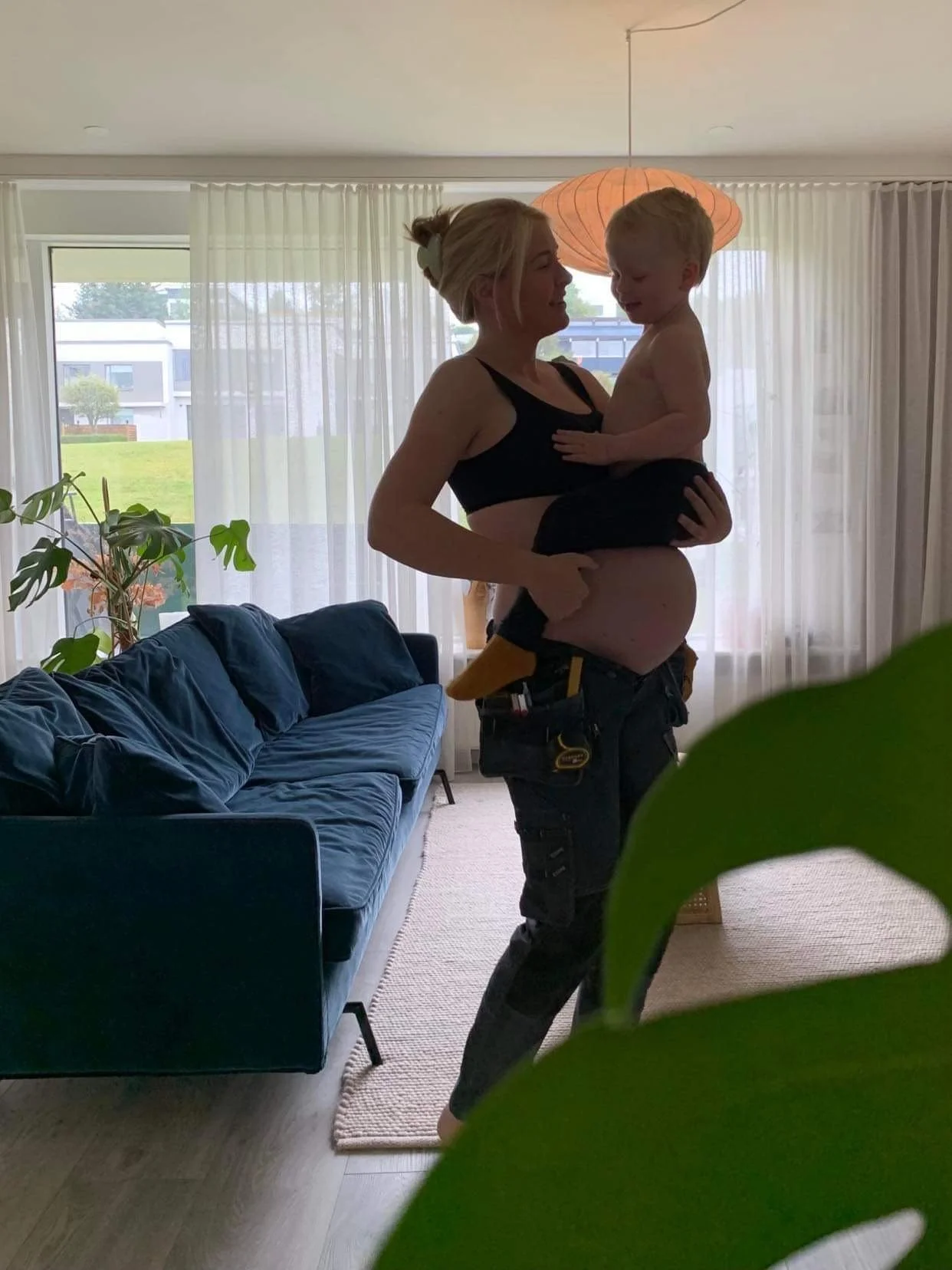
Four days past my due date, Embla came to see me in the evening to try acupuncture. During my first pregnancy, I had tried every myth in the book to get the baby out, without success. I therefore had little hope, but at the very least I enjoyed the visit. As soon as the first needle went in, I felt an increase in contractions — completely painless, but definitely stronger — and they continued until bedtime.
That did not change the fact that I slept well all night, as I had done throughout both pregnancies, but I woke up with the same strong, painless contractions. Feeling hopeful, I promised that if this really was the beginning of labour, I would become the strongest advocate for acupuncture. So I hereby encourage anyone who is out of ideas and has the opportunity, to invite Embla over for acupuncture — because it works incredibly well!
We had a cosy day at home and asked my mother to pick up the soon-to-be big brother from preschool. That evening, we were invited for dinner at my parents’ house, as we were every Wednesday. On the way there, I felt the first real twinge with a contraction, and I had no doubt for a moment that the baby would arrive soon. There had been no long warning period, exactly like in my first pregnancy.
We ate a good meal of boiled haddock, potatoes and vegetables — yes, that was the meal I had requested — and then said goodbye to our son, who stayed overnight with his grandparents for his last night as an only child.
My first birth had taken about 10 hours from the first painful contraction, or around 15 hours from the first twinge. I had felt that first twinge very early in the morning, eaten leftover rice pudding to prepare myself for the work ahead, and then managed to sleep until midday. Yes, rice pudding and boiled haddock — strange, but okay.
Of course, there is no way to know what to expect, but the stories say that the second birth is often shorter than the first, and we were prepared for the possibility that things might move quite quickly.
On the way home, we stopped at the shop and bought “birth snacks”. Then we drove home, closed the curtains, lit candles and, of course, put on the birth playlist. I lay down in bed and tried to rest, but I had no patience for it and instead chose to go into the living room and sit on the yoga ball for a chat.
I sent Emma a message and told her that the baby would probably come that night, but that I had no idea how far along the process was. At this point in my first birth, I had been 4 cm dilated and had already thrown up the rice pudding out of my living room window. This time, it seemed to be much easier on my body, even though the contractions were only about three minutes apart.
Around two o’clock, I became excited about the pool. Emma came to us, inflated it and filled it with water, and I was in the pool by around three.
“Oh, how I have missed you,” I thought as I lowered myself into the water, even though the contractions were still far from unbearable. I accepted that there was probably quite a long task ahead.
In my first birth, I had chosen to give birth at the Birth Center. There, I lay in the bath for about five hours, ocean-breathed my way through the contractions, vomited several times, dozed between contractions and had no idea what was happening around me. I was completely alone with myself and did not dare move even a little finger in case I fell out of “the zone”.
Because the car journey had been the most unpleasant part of that process, I decided this time to give birth at home and ocean-breathe my way through the contractions in a pool on the living room floor — seven slow breaths in and seven even slower breaths out. Also, I live on the fourth floor in a building without an elevator and could not imagine the journey down the stairs.
This time, I felt more secure and trusted myself more to take part in conversations between contractions and to ask questions about what I was feeling in my body, although I was almost completely still in exactly the same position that had worked so well for me last time.
After about two hours in the water, I mentioned that perhaps by this point I should have started sweating, screaming or vomiting. But the atmosphere was so calm that my husband had started heating cinnamon buns and making tea.
As in my first birth, my waters had not broken, and again I did not feel an urge to push. Last time, I had given birth in bed at the Birth Center so that I could be guided through the pushing phase, but this time I wanted to try giving birth in the water.
If anything, the contractions seemed to become milder, but I now felt them more in my back than at the front of my belly. This can indicate that dilation is complete, and Emma guided me to try pushing gently and see whether my body resisted it in any way. I had not been disturbed at all up to this point, except for quick checks of the baby’s heartbeat. Dilation had never been measured.

I focused on “trying to poop in the pool”, but just like before, I had no sense of how the birth was progressing. Embla had arrived by then, though, so it was probably not too far off.
After a few pushes, that unbearable sensation finally arrived. I asked for a sick bag, but peppermint drops eased the nausea. One or two similar contractions followed, and at last I felt the baby moving lower. I told Emma, and she put on gloves. In my mind, I rolled my eyes at the idea that she thought the baby would come soon when the birth had only been unbearable for two or three minutes.
It turned out that Emma was fully aware of what was happening, as she had felt the baby’s heartbeat moving lower and lower into the pelvis.
The next contraction completely threw me off. The pain multiplied, my waters broke and I vomited. There was no break between contractions, and I was still vomiting when the next one began. I felt as if I had completely lost control of my breathing and called out, “Shiiiit,” but Emma responded with the calmest presence and said softly: “No, no, no.”
I regained control of my breathing and reached down to hold the baby’s head, which seemed very eager to shoot out with that contraction. I pushed it gently back in and then guided it slowly and carefully, without actively pushing, until the head was halfway out and the contraction ended.
In my first birth, I had aimed rather high and pushed with all my heart and soul when my unexpectedly 5 kg baby came out, which led to quite a bad tear. This time, Emma guided me so well that my nearly 4.5 kg baby girl did not leave a scratch.
I received her into my arms after the next contraction, screaming loudly and covered in vernix. Then we lay down in bed: father, mother and our brand-new little girl, while the midwives finished the paperwork and then tidied the apartment as if the night had been nothing out of the ordinary. There was nothing we needed to do except rest, breathe her in and enjoy.
I have been encouraged to share my story because of the fear many people have around giving birth to large babies. I myself am convinced that the size of the baby does not determine the progress or outcome of birth. Mindset, trust and good guidance play a much larger role. Without hesitation, I can thank Emma, Embla, Auður at Jógasetrið and my husband for two wonderful births.
There will always be people who feel compelled to question your decisions before and during birth, and even your experience of the birth afterwards. But this is not their moment. It is yours.
We hear all kinds of stories, some that discourage us and others that strengthen us. But with belief in ourselves and a sense of safety in the process, birth can become one of the most magical moments of your life — dreamlike and empowering, no matter how your baby comes into the world.
Hopefully, it is also enjoyable to read about births that go well. At the very least, it is important.